Before commencing tailoring work, familiarize yourself with the principles of proper material handling. You have to learn how to calculate the amount of raw material needed, cut the parts and connect them correctly. If we use patterned material, parts of the product should be joined in this way, so that the motifs on the fabric match each other after sewing. The same applies to pieces of material intended to be placed side by side, np. parts of curtains. Before cutting the material, it is a good idea to place it on the piece of furniture, who wants to cover himself with it, to evaluate, what it will look like and whether the pattern has been well chosen.
 ARRANGEMENT OF PATTERNS
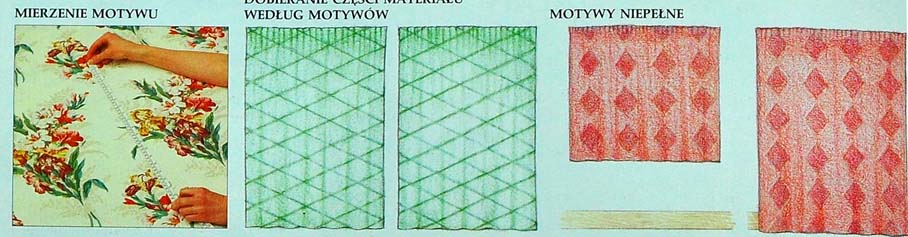
If we intend to use patterned material in our interior, we should check first, whether the pattern layout matches the window or upholstered piece of furniture. Patterns must match along all joints of the parts of the material. We measure the size of the decorative pattern repeated on the fabric with a tape measure. This information can be useful in calculating the amount of material required.
MEASURING A MOTIF
Manufacturers generally indicate this on the fabric edge or on a tag attached to each bale. We can also measure the distance between identical motifs on the material ourselves.
SELECTING PARTS OF THE MATERIAL ACCORDING TO THE MOTIVES
We must be especially careful when sewing curtains, so that the patterns on each of them are at the same height. After the curtains are pulled down, these patterns should complement each other. It is best to trim one curtain first, and then adapt the other to it.
PARTIAL THEMES
When we measure the length of curtains or blinds, it happens sometimes, that the pattern motif will be cut. An edge with an incomplete motif may end up at the bottom or top of the curtain. Short curtains look better, when the cut motif is at the top of them, while on the curtains to the floor - downstairs.