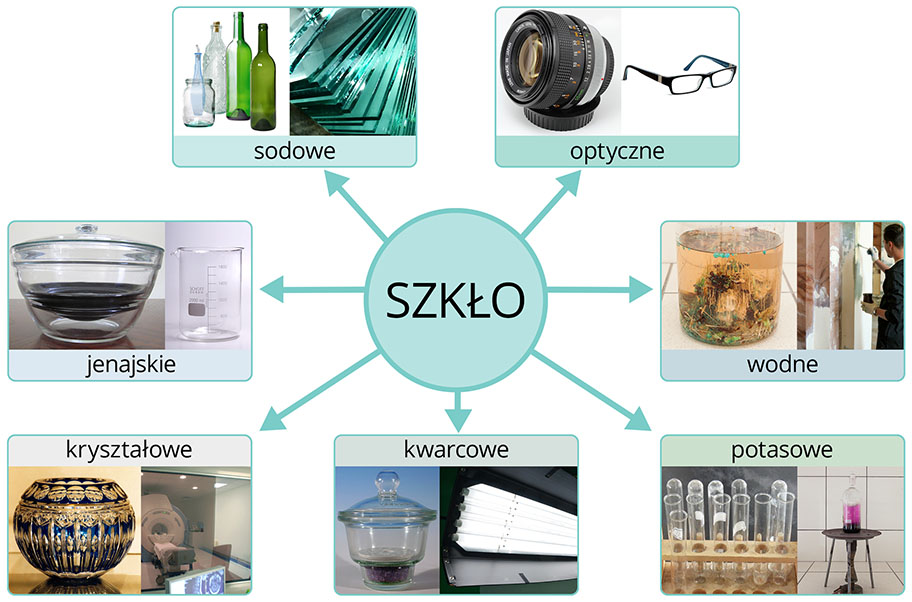
In Poland, there are all the raw materials needed to create a glass set.
The basic raw materials are: sand, baking soda (artillery), limestone (stabilizer).
Sand – (mainly silicon dioxide SiO2) - natural ingredient, glass-forming, is approx. 3/4 whole glass mass. An increase in SiO2 content contributes to an increase in chemical resistance. Except for silica, iron oxides may be present as impurities in glass sand(III) (Fe2O3), aluminum (Al2O3), titanium (TiO2), which affect the properties of the glass. When choosing sand, as a raw material for the glass industry, attention is paid to the chemical composition, its graining, mechanical pollution.
Soda (gunner):
• sodium carbonate (Na2CO3) it is an artificial material, obtained from rock salt (NaCl) in the presence of ammonia (NH3); sodium carbonate
decomposes into carbon dioxide (CO2) and sodium oxide (On2THE), which lowers the melting point of silica and affects the properties of the glass;
• potassium carbonate (K2CO3), as it decomposes, it forms carbon dioxide and potassium oxide (K2THE); this oxide plays a similar role in the glazing set, like sodium oxide.
Limestone (stabilizer) - calcium carbonate (CaCO3), that is, limestone decomposes into carbon dioxide at a certain temperature (CO2) and calcium oxide (High). The calcium oxide prevents the glass from dissolving in the water, increases the gloss and durability, makes it resistant to weather conditions. In addition to calcium carbonate, red lead is often used as a stabilizer (2 PbO • PbO2). This double lead oxide contributes to an increase in the refractive index.
Depending on the type and application of glass, and due to the maintenance of appropriate conditions for the course of the technological process, are used in addition to the listed basic raw materials:
• boron oxide (B2THE3) - it lowers the glass melting temperature and is used for the production of technical glasses;
• zirconium dioxide (ZrO2) - increases chemical resistance, increases the refractive index, it is added to optical and technical glasses;
• lithium oxide (At the2THE) - it significantly lowers the melting point of the glass batch, increases the resistance of glass to temperature changes and is used in the production of technical glasses.
Do auxiliary raw materials include, among others. clarifying agents, raw materials for coloring and raw materials that cloud the glass.
Clarifying agents to: salt (sodium or potassium nitrate), arsenic, sodium sulfate, chlorine and fluorine compounds. These compounds are used to remove gas bubbles from the glass mass, one of the products of chemical reactions, occurring during the technological process.
Coloring raw materials, np.:
• manganese compounds (Mn) i nickel (In) color the glass purple;
• cobalt compounds (Co) i copper (With) they color blue;
• iron compounds (Fe) i chromium (Cr) they color green;
• sulfur compounds (S), iron (Fe) with the addition of manganese, cadmium (Cd) and silver (Ag) they color yellow and brown,
• copper compounds, gold and selenium stain red.
The raw materials that cloud the glass are fluorine compounds. They create a light scattering suspension; then the glass is opaque, dairy.
Moreover, the glass raw material is glass cullet, generated as a waste material during the technological process, as well as it is obtained as a result of the collection of used glass packaging. The addition of cullet to the glass set primarily reduces production costs, accelerates the melting of raw materials, and also contributes to the protection of the environment.