Where does the cork come from?
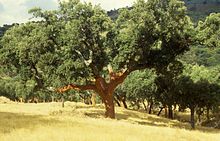
Cork is obtained almost exclusively from cork oaks, because only
they produce a uniform bark. Admittedly small amounts
cork is also harvested in Brazil from the tree “Pau Santo” (Kielmeyera
leathery) and a little in Japan from the local oak, Oak tree,
but only the bark of the cork oak has been called cork.
Cork oak comes from the Oligocene of the Tertiary era, that is, speaking to others
words from time, when the Mediterranean Basin began to form. The oldest
cork fossil was found in Portugal, in the Tagus valley
and its age is estimated to be about ten million years. In contrast
for most oaks, cork oak ( occurring in biological systematics
as Quercus suber L. ) it is evergreen, whose
leaves usually change every two years. Cork oaks live on average
about 150 years, although there are two-hundred-year-old trees. In Portugal
they bloom from April to June and sometimes in August and September. Fully
overgrown cork trees have from 9 do 12 meters high and trunks
with a diameter from 0,9 do 1,2 metra, but there are many old fifteen-meter trees
and higher, with a diameter greater than 2,5 meter at the base. Oak
cork has a large single trunk, which is usually quite short and on
only a few meters high, it projects horizontally inclined branches,
which keep growing. The crowns of young trees are round, but later
they grow across rather than lengthwise, which makes the cork oaks majestic
appearance. Centennial cork oaks can cover the area with their branches
above 500 m?. The best conditions for the development of cork oaks are present
only in a small part of the western Mediterranean basin
: in North Africa (Morocco, Algeria, Tunisia), in southern France
( especially in Corsica ), in Italy, in Spain and Portugal.
In the latter country, cork forests constitute 22% forest area and you can
meet them almost everywhere. Worldwide, the traffic jam is occupied
2 200 000 ha, of which 660 000 ha is in Portugal, 460 000 ha in Algeria,
440 000 ha in Spain, 350 000 ha in Morocco, 110 000 ha in France
i 90 000 in Italy and Tunisia together. In recent years, it has started
in Portugal, systematic afforestation of wastelands with cork oaks.
World cork production reaches approx 300 thousand tons per year, of which
ok. 50-60% is exported to the USA. A serious consumer of cork on the market
world is also, paradoxically, same Portugal, which imports
ok. 10% world production, mainly from African countries and processes
cork from other countries. Portugal thanks to significant investments made
in the 1960s, it now has a modern cork processing industry.
W 600 plants in this industry are employed there over the years 14 thousand.
employees, who produce the past 70% the world's cork products.
In this way, Portugal has become the undisputed market leader
above – ma 30% acreage of cork forests, 50% world production i 65%
industry. Bottle stoppers are still the main cork product, which
constitute approx. 55% all exports of cork products. Acquisition
wood from the forest is inherently associated with its destruction.
Suffice it to say, that for the performance 45 m2 parquet
two healthy ones have to be cut down, 50-summer oaks, and for the performance
20 m2 Three 40-year-old pines have to be cut down in the pine paneling.
For lining the same surfaces with parquet or cork paneling
not a single tree needs to be felled. Happening
that's why, that in the case of cork oak the most valuable is obtained
the raw material is not wood, but the bark, which what 9-10 years breaks off with
living trees without any harm to them. The bark of the cork oak
grows in two layers. The inner cortex is alive and acts as a base,
on which a new outer bark grows every year. During the annual
bark increments, its outermost layer ceases to be
the living part of the tree. It only serves as insulation to protect the tree
against temperature changes. It is this protective outer cortex that can
be removable, in a procedure called strypping, no harm to the tree.
The debarking of trees is entrusted only to very experienced workers
and the weather is carefully selected. Harvesting takes place in spring or summer
when the tree grows and forms new bark quickly. Debarking is carried out
manually, with slight changes over the centuries special,
with an ax sharpened on both sides or with a curved saw. First it does
two cuts are made around the trunk, one close to the ground and the other right next to it
below the main branches. Two vertical cuts are then made
and the outer cortex is carefully separated and peeled off with a lever
and wedges. Sometimes larger branches are also debarked. After breaking the bark
“wound healing” runs automatically and takes approx. 3 months. Broken off
the bark is stored in the air in piles for several dozen days.
After this period, the bark slices are boiled over steam or in water for approx.
60-75 minutes to remove the forest fauna and flora from the cork, tannins
and juices. The cooking process makes the bark softer and more pliable, co
allows you to straighten it. According to the strict regulations on
The first stopper harvesting cork cannot be removed before the stump
the tree does not reach the perimeter 60 cm, the limbs will not reach a diameter of 15 cm,
and subsequent debarking may not be carried out before the expiry
9 years. Average productivity , based on sourcing cork in ten years
cycles, is 150 kg of cork per hectare. But in Portugal, in large
cork forests achieve results of the order 2 – 2,5 tonnes per hectare, a
even 5 tons per hectare. From the moment of planting a cork oak by
20 for years they did not supply a significant amount of cork. At the age of 60 years
the tree produces only 65 kg of cork per year. Only the trees of the 80's
summer give approx 225 kg of cork.
Cork currently obtained on an industrial scale is a material of
many unique properties. Due to its cellular structure
(1 cm2 the cork parenchyma contains from 30 do 42 million cells
filled with gases similar in composition to air without carbon dioxide
coal) has found multiple applications in various fields, too
successfully in construction. In the sixties of our century
two-layer cladding was introduced: composed of a base layer
flexible cork agglomerate covered with a decorative layer of sheets
or cork veneer. Thus, a previously unknown flexibility was obtained
and the hardness of a thin plate. This is how paneling and cork parquet were created.