Cork layers
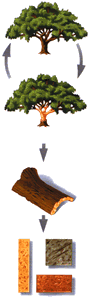
In the cultivation of cork oak, the main goal is to achieve a high-quality yield. Cork is a natural material with various applications in many sectors of the economy, such as the wine making industry, various branches of construction, aviation industry, footwear or leathercraft.
structure
Cork is the name colloquially given to the cork tissue formed by
trees of evergreen cork oaks. It is a plant tissue
made of dead microcells – about appearance 14 wall polyhedra
hooked into each other – with intercellular spaces completely
filled with a gas mixture almost identical to air.
1 cm3 cork tissue contains over 40 million of these
fourteen-sided cells. The composition of such a cell is: 45% suberin,
27% lignin, 12% cellulose and polysaccharides, 6% his land, 5% wax and
5% other small substances.
Diversity
Not all corks are the same. The scale of the diversity is wide and
dependent on various factors influencing the tree throughout
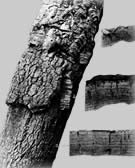
period of his life. The influence of these factors can be traced in layers
cork bark similar to the cross-section of a tree trunk. Protective bark
outer can be removable, in a procedure called strypping, no harm
for the tree. Debarking is carried out every 7-9 years. Can distinguish
three types of cork tissue throughout the life cycle of the cork oak. Are
to:
- Virgin – virgin cork, it is the tissue obtained from the first
corona. It is harder and has an irregular structure.
Peripheral cells are responsible for the growth of the next layer of cork,
which become alive, are broken down (growth) and give rise to
the layer finally forming the cork . This layer is called phellogen. You can
tell, that this layer acquires its own identity beneath the layer
dead cells, creating more millimeters of growth. After the first
debarking (when the tree is approx. 25-30 years) new phellogen coming soon
begins to generate another layer of cork much thicker than virgin.
After another 9 years a layer is formed: - Secondary cork – it is the first layer in the reproduction process,
it is thicker and flatter than virgin. The best layer for
production goals is: - Amadia – with the greatest thickness, thick and about the most
regular structure. The age of the tree then reaches approx. 45-50 years.
The thickness and quality of the cork increases with each subsequent debarking.
Debarking processes can be carried out up to 150 year old oak
cork