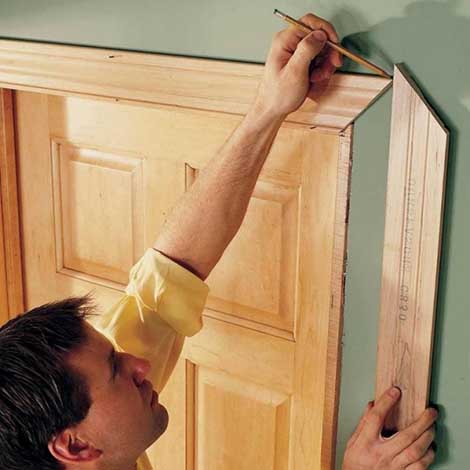
Decoration of wooden frames – door frames
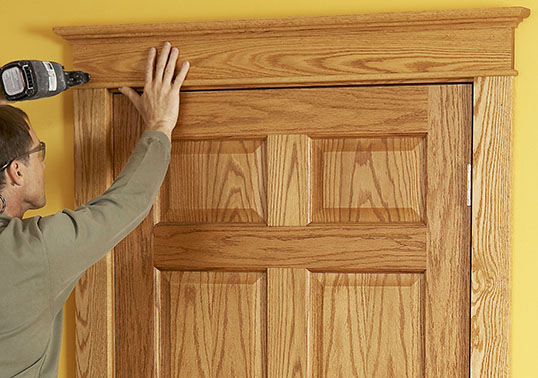
Veneered door, which are widely used today, is embedded in standardized metal frames (the most commonly used) or wooden. Wooden frames after brickwork, plastering and possibly painting, can be covered with a material similar to the veneer glued on the door.
Already during the bricklaying process, the vertical frame should be secured against warping (inward bend of the door). Therefore, halfway up it is a good idea to insert a flat head screw with a diameter 10 mm and a length of 100-150 mm, which will be a good anchor. It is a necessary procedure then, when the door frames are made of logs, whose thickness after sharpening is only 45 mm.
The door frame lining can be made of solid wood or a veneered board. It is stuck to the door frame (drawing).
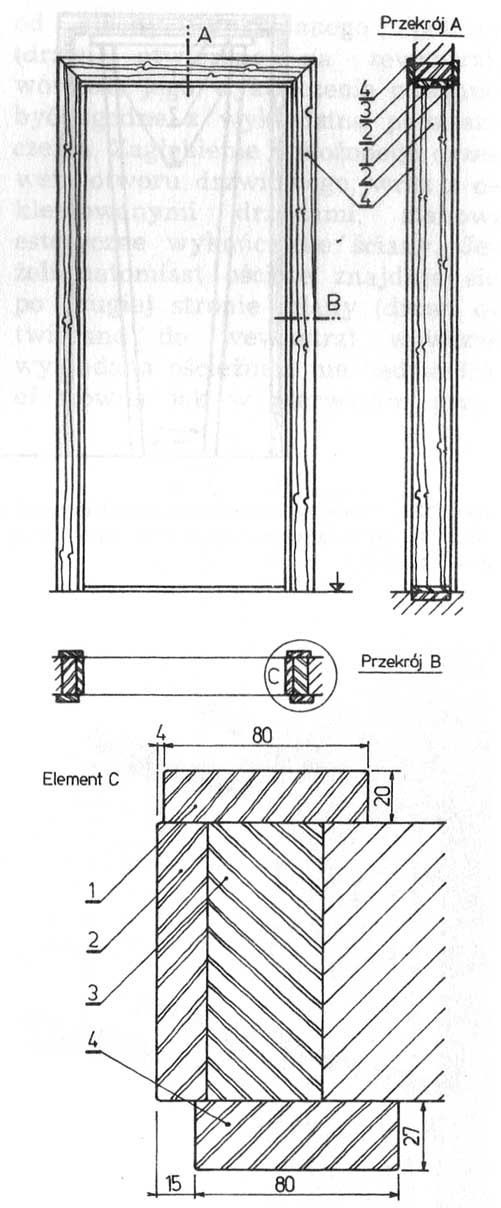
Drawing. Wooden door frame upholstery (section): 1 - blind facing, 2 - jamb, 3 - frame, 4 - carpet.
The flooring boards should be processed before they are cut to size. First, the boards are cut diagonally, and only then perpendicular, exactly according to dimensions. It is recommended that the already made parts should be placed on the frame and fastened with carpentry clamps, so that the remaining elements of the covering can be fitted without any gaps and inaccuracies.
Surface finishing should be done before assembling the elements. The horizontal arrangement of the varnished boards guarantees the high quality of the paint coating. When using matt synthetic varnish or nitro varnish, installation can begin after 48 at. from applying the last coat. The epoxy varnish is hardened for 4-6 days. A long hardening period of the varnish is essential, because the assembly uses clamps with washers, which could be imprinted on a poorly dried varnish coat.
The installation of the lining begins with the top jamb. After cutting and adjusting the plank between the vertical frames, it is immediately glued. It is best to use wikol glue for this purpose. It is applied pointwise in several places (about 15 cm²). There is no need to coat the entire surface, in addition, it can cause the board to twist.
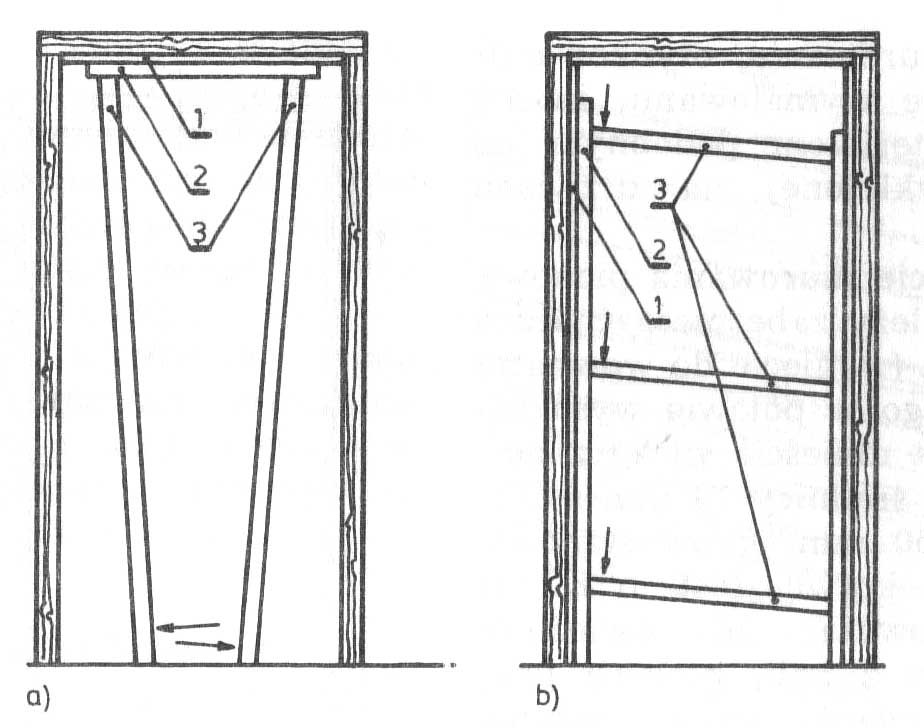
Drawing. Ways of pressing the glued door jamb lining: a) pressure of the upper jamb, b) simultaneous pressure on both side jambs: 1 - jambs, 2 - washers, 3 - contradictions.
The board is pressed against the upper jamb through the pad with struts (Lynx. a). After 20 —30 min. the struts can be removed and the vertical boards can be glued to the reveal in a similar way (Lynx. b). When embedding the boards of the jamb, the sides should be carefully aligned with the frame. Because it is virtually impossible to completely flush the width, planks for lining the casing should be made by approx 0,5 mm wider than the frame. This prevents the formation of a gap between the cladding of the jamb and the side of the frame.
The side coverings also stick to points. Joiner clamps are used to compress the glued elements (drawing).
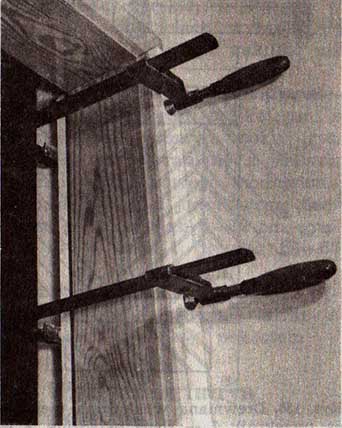
Drawing. Pressing down the door frame lining with carpentry clamps during the hardening period of the adhesive (installation without the use of screws or nails).
You can stick both sides at once, or one first, then the second. The latter way is simpler. The threshold is cut to size and fitted last, after the door is installed.