 Knowledge of hand and machine sewing techniques is essential for all tailoring work, that the finished product is durable and carefully finished. It is also important to choose the right stitch to connect the cut parts of the fabric. We can choose stitches, French, maritime (overlock), flat and overlap. Before we choose the right stitch, we have to decide, what the seam is supposed to be used for and what it should look like.
The easiest and most versatile way to join two pieces of fabric is flat stitch. Before starting sewing, we connect some of the fabric, we fasten with pins and baste.
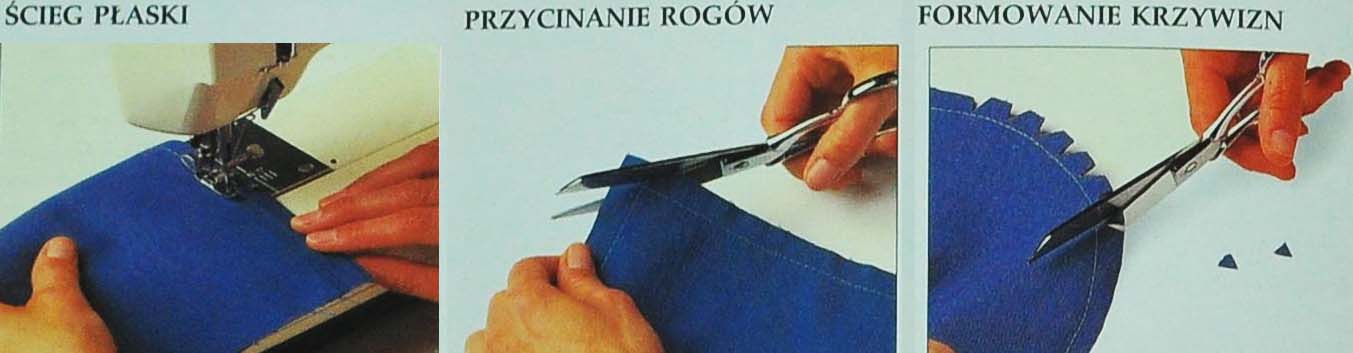
FLAT STITCH
We bind and baste parts of the fabric, to be sewn together. Place them under the foot of the machine and press. We strengthen the end of the thread by sewing several times over 1 cm back and forth along the seam line. We make the seam to the provided length, then we end the same way, as we started. We remove the basting and flatten the seam. When trying out a new stitch or fabric with a new texture, it is a good idea to sample the stitch on a scrap first, to check, the machine is well positioned.
By appropriate trimming of the seam stocks, we achieve alignment of the corners and curves. At the corners, a triangular corner of the fabric can be trimmed, the curvature should be notched.
TRIMMING THE CORNERS
After making the seam, trim the remaining stock, leaving approx 6 mm between the seam and the cut edge. Otherwise, when turning the work inside out, the supply left behind the seam may fray.
FORMING CURVES
For that, where the seam forms a relief, we cut the edge into cloves, so that it does not wrinkle and frown. In place of, where the curvature forms a concave gap, we cut the edge, to prevent the material from pulling out. We think, so as not to cut too close to the seam.