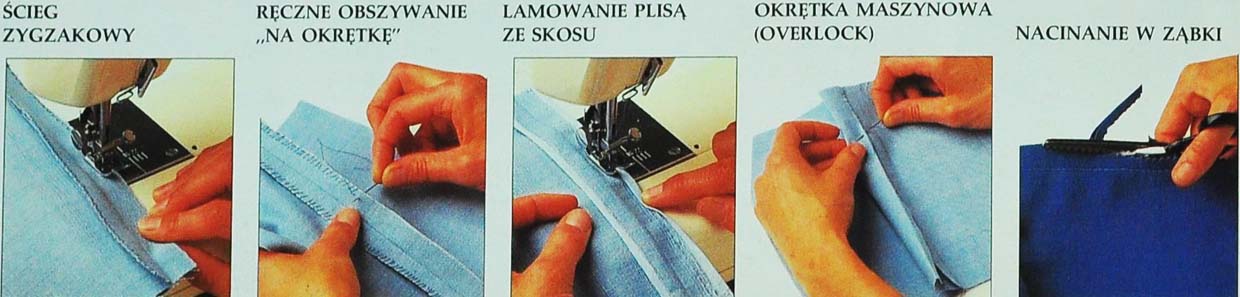
 Non-hemmed edges of the fabric should be protected against fraying. This is especially important in furniture upholstery, which must be durable. You can protect the edges by sewing them with a swivel by hand or by machine, piercing with a zigzag stitch, by trimming with a beveled pleat or by cutting into serrations. The most commonly used technique is zigzag stitching. If we make a binding with a diagonal cut pleat, you will not see the unbound edge. It is also not visible in the ship stitch pattern, but you need to stock up on material for that. If the left side of the product and no seams are to be visible, a French seam can be used.
ZIGZAG STITCH
We set the machine for a zigzag stitch. We put the edge of the fabric under the needle, we tighten the end of the thread, sew the fabric as close to the edge as possible and finish.
HAND STITCHING "ON BOAT”
We make evenly spaced stitches going from the left side of the fabric to the right side over * its edge. Let's not tighten them too tightly, so as not to wrinkle the edge of the material.
BEVEL BINDING
We juxtapose the edge of the pleat with the edge of the fabric, we pin with pins, baste and sew. We fold the pleat, tuck and sew through all layers.
MACHINE SHIP (OVERLOCK)
Sew both parts of the fabric 2.5-3 cm from the edge. One edge of the stock is cut to 5 mm. We wrap a wider edge, by hiding an unshaped edge underneath. We pin the bet and throw the swivel.
NOTCHING IN THE RIBS
We cut the edge with serrated scissors - instead of hemming. However, the edge finished in this way is not very durable, so it's best to only finish the inside seams this way.