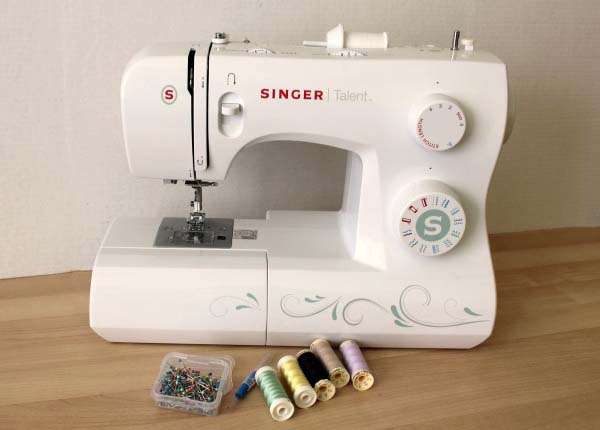
 That our tailoring works are done professionally, you need the right equipment and a tidy workplace. Sewing accessories should not be used for other purposes. We should find a lot of space adapted to the work, which we want to perform. If e.g.. we want to cut and pin up long curtains, the only suitable surface will be the floor. When arranging a workshop, let's remember about comfort. The chair should have a solid backrest, and the table has a chosen height, so we don't have to humble ourselves. Lighting the room is also important, especially if we rely mainly on artificial light.
CUTTING ACCESSORIES
So that the product can be adjusted and hung evenly, the material must be cut exactly. This requires sharp and comfortable scissors. Let's try not to use them for other farm work, because they will quickly become dull. For cutting out patterns (templates) tailor's scissors are the best, for cutting out pattern details - small embroidery scissors, and for securing the edges of the fabric - serrated scissors.
IRONING ACCESSORIES
The iron is used not only to iron the finished product, but also during processing, np. for pressing seams, hems and edges. A steam iron is best, because it is not only the weight of the iron and the heat it generates that contributes to smoothing the material, but also moisture. The ironing board should be adjustable in height and soft, well-fitting and easy-to-clean cover.
SEWING MACHINE
On the machine you sew faster and easier than in your hand. Modern sewing machines are easy to use and have many functions, np, sew straight stitch, zigzag and are used to finish the left side. Most of the machines produced today have additional equipment, np, a special foot for sewing in zippers. Let's remember, so that you always have a spare bobbin ready and wind it on it before you start sewing.
SEWING ACCESSORIES
Pins should be made of stainless steel, usually or with colored heads (you can see them better on the material). For safety and easier access, the pins should be kept in a box or stuck in a pillow. Depending on the thickness of the material, the appropriate length and thickness of the needles can be selected. Threading them will make it easy, a little fixture. We choose the threads according to the color, the type and thickness of the material. Special basting threads are available in a wide range of colors, and from sewing thread they differ in this, that they can be picked more easily.
INSTRUMENTS FOR MARKING AND MEASURING
It is important to take the measurements accurately and clearly mark the measurements on the material. A tailor's tape measure made of non-stretchable tape will help you accurately measure even curves and corners. The markings on the material should be in a contrasting color and easy to remove. The best for this is a tailor's soap or a special marker - a marker with disappearing ink (znikopis). Need caution, not to iron the fabric until the marks are completely removed. The upholstery material should generally be cut at right angles. Big is helpful when determining right angles, transparent set square.
ADDITIONAL EQUIPMENT
Group, a blunt needle with a large handle is used to thread the strings, ribbons or rubber bands through thick fabrics or tunnels. The seams can be washed quickly and easily using a special tool. When temporarily pinning the material to something rigid, np. interlinings, or when dressing the frame of the lampshade - clothespins will come in handy, Wrapping paper, Tracing paper or xerographic paper will be useful for making patterns and patterns.
UPHOLSTERY TOOLS
Making ordinary and quilted upholstery for furniture is facilitated by several special utensils. Long upholstery needles, available in various sizes, they are very useful for quilting and button stitching. When covering simple pieces of furniture with the material, np. footrests, Upholstery skewers are useful. However, they can only be used for thick materials, because the thin ones can tear at the same time.