Despite the multifunctionality of currently produced sewing machines, in some cases there is no substitute for hand sewing. Sometimes only hand sewing gives the desired effect, and sometimes it complements sewing on the machine, np. the best way to pre-prepare and match pieces of fabric to each other is basting. To make the stitches almost invisible, Before starting manual sewing, select the thickness of the needle to the fabric weave, and the color and thickness of the thread - to its color and thickness. Right-handed people should start from right to left, left-handed people - the opposite.
High heels and bartack
Before sewing, the cut parts of the fabric are joined with pins and basting. Pins should be inserted perpendicular to the fabric weave. We use threads of a contrasting color for basting. After sewing the cut parts, remove the basting.
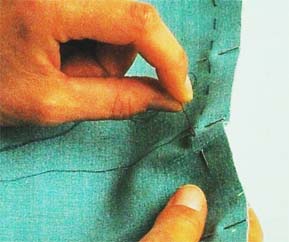 JOINING PARTS OF THE MATERIAL
Fasten the cut parts with pins. Secure the end of the thread against slipping out, sewing it through a single stitch or tying a knot at its end. The basting stitches should be approx 1 cm (or alternately 1,5 cm) on the right side of the fabric, a 0,5 cm on the left.
CIRCULAR STITCH
This stitch, also called indoor, is used for the invisible hems or seams on the right side of the work. An example of using this stitch is sewing up an opening, through which the almost finished product is turned to the right side.
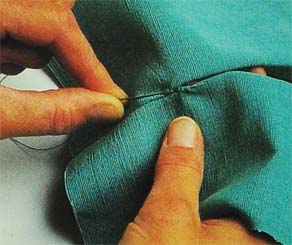 SEWING THE HOLE
We secure the end of the thread and pull the needle through the hole. On the part folded along the seam line, we make a stitch with a length of approx 2 mm. We pull the thread underneath to the other side of the hole and make the same stitch on the upper side of the seam. After sewing the opening, we finish the seam.