Metal or plastic zippers in many thicknesses, The lengths and colors are both sturdy clasp, and hardly visible. Suitable for all products, except made of the thinnest materials. Metal locks are stronger, but plastic comes in a wider variety of colors and is more flexible. You just have to be careful when ironing, so as not to damage them.
LOCK IN THE CENTER OF FASTENING
1 PLACING THE LOCK IN A MARKED PLACE
We choose a lock suitable for the material and check it, is it long enough. We put the zipper on the seam line on the left side of the fabric. We mark places, both of its ends fall.
2 PREPARING THE PLACE FOR SEWING THE LOCK
We sew the parts of the fabric on both sides of the fastener, starting from the edges of the fabric, and ending with pins marking the places where the zipper is sewn. We baste the edges of the zipper opening between the pins and flatten the stock on the seam line.
3 BINDING THE ZIPPER
We put the fabric right side down, with stocked around the seam. We put the zipper on the basted part of the seam also with the right side down. We make sure, that it lies right in the middle, notches on the seam line. We baste the zipper on this point.
4 SEWING THE ZIPPER
Turn the fabric right side up. We sew all layers around the zipper on the machine using the zipper foot. We try, so that the seams come out approx 8 mm from the zipper teeth. We remove the basting.
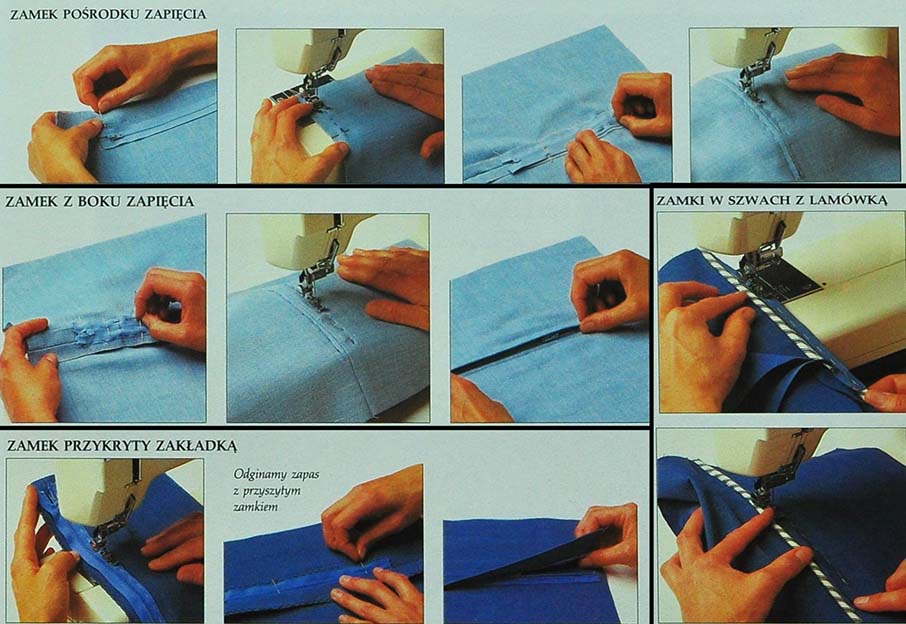
Zipper on the side of the fastener
1 BALL STRIPING
We follow p. 1 i 2 above. We put the zipper in the basted place, moving it more to one side, so that the teeth are under the seam allowance. We pin it there and baste it.
2 SEWING LOCK
Turn the fabric right side up. We sew all the layers around the zipper on the machine, using the zipper foot. We try to sew along the line marked with basting.
3 LOCK FINISHING
We take out the basting. The zipper sewn in this way is much less visible than passing through the center of the fastener, therefore it is a good method of disguising a zipper that does not match the material.
THE LOCK COVERED BY A TAB
1 PLACING A LOCK
At the top of the seam line, we leave a place for the zipper. We fold both stocks to one side. Turn the fabric right side up and unwrap the part from the top. We pin, We baste and sew one side of the zipper right side up on the lower stock.
2 SECOND PAGE
We place the folded top of the fabric over the zipper and group both stocks together around the seam. We turn over parts of the material. We pin and baste the free side of the zipper to the free margin at the seam. We turn it right side up, we open the zipper and sew the hem.
3 LOCK FINISHING
In this way, both stocks around the seam are on one side of the zipper, hiding it underneath. The zipper is completely masked with the upper seam stock. it is a zipper sewing method commonly used in sewing various chair and sofa covers.
Zippers in the seams with a piping
1 SIDE WITH A TRIM
We put one part of the open zipper right side down, towards the boundary. We pin it, we baste and sew on the machine using the zipper foot.
2 SMOOTH SIDE
We close the lock. We bend the stocks on both sides of the seam. Place the page without a border on top of the lock, so that it touches the bound side. We pin, we baste and sew the zipper in this place.