Haftki
Hand-sewn metal hooks are a simple device for joining parts of the product with a butt joint or an overlap. They are hardly visible, available in many sizes in bulk or already sewn on plastic tapes. They hold very tight, bearing a heavy load, therefore they are suitable for fastening upholstery and covers for furniture.
SINGLE EMBROIDERY
1 DEFECT
We mark the places with pins, in which we want to attach hooks, putting them at 5-10 cm. Holding the lug, sew it by hand 5-6 times through each buttonhole.
2 HOOKS
We match them on the opposite side of the ears and sew them over the top of the neck through the holes, if the stocks on both sides of the seams open up, overcast their edges with a hemming stitch.
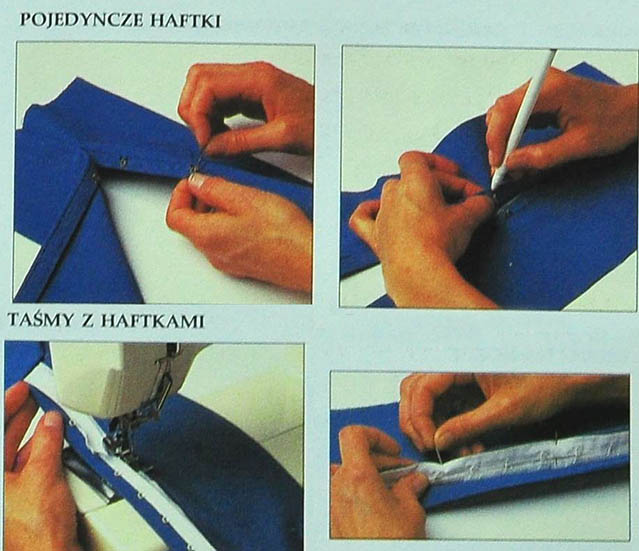 TAPES WITH EMBROIDERY
1 FIRST PAGE
The stocks on both sides of the seam must be wider than the webbing. We secure the places where the tape is cut off. To the reserve on one side of the seam we attach a tape with ears, baste and sew. You can use a zipper foot for this.
2 SECOND PAGE
We adjust the tape with hooks to the tape with ears. We fasten the hooks, fasten the tape with hooks on the underside, we unfasten the hooks, and baste the tape. Sewing two layers of fabric leaves visible stitches. If we sew the tape to only one layer, reinforce the stock with a hemming stitch, so that it does not open up.
Bindings
Compared with ready-made bindings (sometimes called drawstrings) have a completely different effect. Flat ties are easy to sew and sew, and in the case of bed linen or pillows, they provide an additional decorative effect. Rolls stitched from diagonal pleats can also be used for tying. They can also be used to make loops instead of buttonholes.
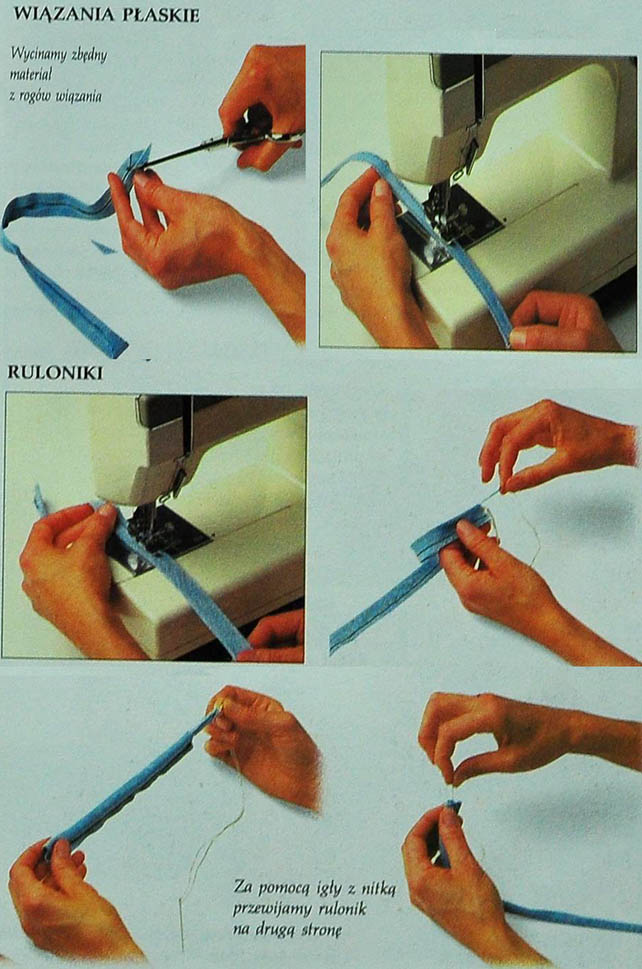
FLAT BINDINGS
1 TRIMMING THE ENDS
We cut the fabric to the desired length and double width, adding on all sides after 1 cm for stitching. We put the edges after 1 cm towards the left side is pressed. Cut the ends diagonally, bend inside out and press.
2 STAPLING
Fold the cut strip of the fabric in half with the left side towards the center. spinamy, we baste and sew on all sides approx 2 mm from the edges. We prepare the second binding in a similar way. We sew them on both sides of the opening and tie them with a knot or a bow.
 ROLLS
ROLLS
1 STITCHING RULLONIC
Beveled width belt 2,5-3 cm fold in half lengthwise with the right side inwards, We iron the fold and sew the edges at a distance 6 mm from the edge.
2 PULLING THREAD
Through a thick ear, thread a strong thread or twine through a blunt needle, Attach the end of the thread to one end of the roll and insert the needle into its tunnel.
3 WINDING RULONIC
We pull the needle through the tunnel to the other side, pulling the thread with the other end of the roll attached to it. We drag the entire roll to the right side.
4 FINISHING RULONIC
We cut the thread, with which we scrolled the roll. We push the ends of the roll to the inside and sew the top with fine ones, with little visible stitches.