Hoops and horns
Home-made tailoring and upholstery products look neat, if they have carefully made hoops (called lie bets) and finished corners. This is as important as choosing the right material or type of seams. The type of the girdle depends on the thickness of the material and the size of the furniture covered with it. For larger items and thicker material, the hem must be wider, and with small objects made of thin material, it can be narrower. Correct execution of diagonal corner connections is especially important in the case of wide hems.
Circles
The width of the hems can vary from 5 mm do 15 cm. If we don't care, to make the stitch invisible, we can sew them on the machine. We set it on a straight stitch, zigzag or - if the machine is equipped with this function – for blind hem. If we want to, that the stitch is invisible, we sew the hem manually. We use threads a bit darker than the fabric.
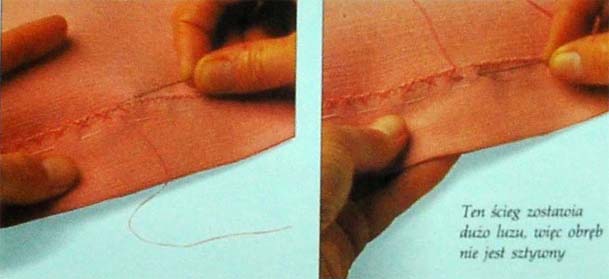 SINGLE HEAD LINED WITH CROSS STITCH
1. PRELIMINARY STEPS – This stitch is most often used for hemming the girdle of products made of thick fabrics. We secure the edge of the fabric by sewing it on the machine with a zigzag stitch. We assume the hem to the desired width, we pin with pins and baste. Pick up a few threads on the needle from the main part of the fabric on the side opposite to the sewing direction.
2. HITCHING A RIM Pull the needle out under the threads you pick up. We cross the thread with the already made stitch, piercing it in the direction of sewing. We make a stitch through the hem to the back. We repeat this action, each time crossing the next stitch with the previous one.